Skip to content
Are you thinking about turning your passion for beauty into a real career? Understanding what qualifications you actually need can feel confusing, especially when trying to work out the difference between legal requirements and professional standards.
Whether you dream of opening your own salon or working as a mobile therapist, knowing exactly what you need is the first step toward building something successful!
It’s easy to get conflicting advice online, especially when different councils and training providers say different things.
This guide walks you through the essential requirements, the importance of accreditation, and how to choose the perfect nail technician course to launch your future.
Do you legally need a nail technician qualification in the UK?
One of the most common questions aspiring beauty professionals ask is whether they actually need a qualification to start offering nail services. The answer sits in a bit of a grey area within UK legislation.
Unlike the medical profession, there is currently no national law in the United Kingdom that explicitly states you must hold a specific licence to work on nails for money. However, this does not mean the industry is unregulated!
While national law might be silent, Local Authorities hold significant power. In reality, many technicians only discover these requirements when they try to apply for a licence or insurance and are asked to produce their certificates.
Under the Local Government (Miscellaneous Provisions) Act 1982 (and specific acts like the London Local Authorities Act 1991), most councils require businesses to hold a Special Treatments Licence to offer services like manicures, pedicures, or nail extensions.
To grant this licence, the council will almost always demand proof that all staff members hold a recognised qualification, typically at Level 2 or Level 3 standards, or an accredited equivalent.
On top of this, under the Health and Safety at Work Act 1974, you have a legal duty to keep your clients safe. If a client suffers an injury or allergic reaction and you cannot prove you were trained to handle chemicals like methacrylates or operate e-files safely, you could face serious legal consequences.
So, while you might technically start without a paper certificate, you cannot legally operate a compliant, licensed business without one.
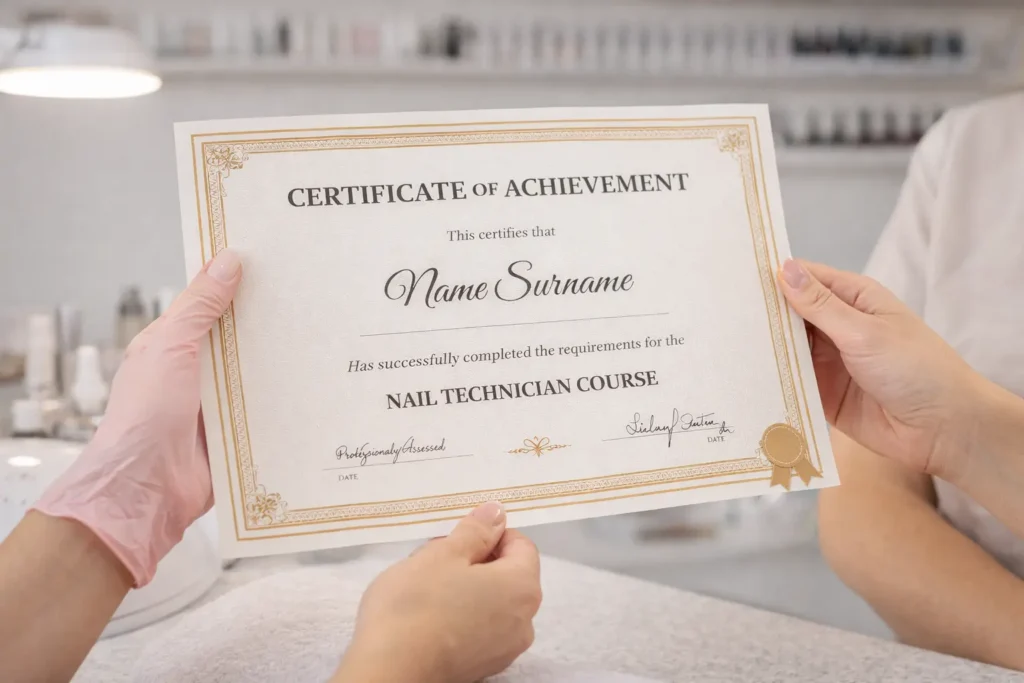
Recognised qualifications are often required by councils and insurers before you can operate legally.
Why qualifications matter even if they are not legally required
Even if you live in an area with lenient council licensing, attempting to work without professional training is a massive risk to your career and financial security. The primary reason qualifications are non-negotiable for serious professionals is insurance.
To work legally and safely, you need Public Liability Insurance and Products Liability Insurance. These policies protect you if a client sues for damages, for example, if they develop a severe infection from a manicure or slip in your salon.
Insurance providers are extremely strict; they will not cover a therapist who cannot provide a certificate from a recognised training provider.
If you are uninsured and something goes wrong, you are personally responsible for the costs, and those costs can quickly become overwhelming.
Beyond protection, qualifications build trust. Clients today are savvy; they know the difference between a hobbyist and a pro! Displaying a certificate proves you understand:
- Anatomy and physiology: Understanding the nail matrix and skin structure
- Chemical safety: Handling acrylics, gels, and solvents correctly
- Hygiene protocols: Preventing cross-contamination and fungal infections
Your certification is your passport to practice. Training Beauty & Beyond’s fully accredited nail technician course provides you with the insurance-acceptable qualifications necessary for professional practice, so you can be covered, confident, and credible from day one.
What makes an accredited Nail Technician Course recognised in the UK
When searching for a nail technician course, you will frequently see the word “accredited.” But what does this actually mean for your career? In the UK beauty industry, accreditation is the seal of approval that validates the quality and professional standard of a training programme.
An accredited course has been audited by an external professional body to check it meets specific industry criteria regarding curriculum depth, health and safety standards, and assessment methods.
When a course is accredited, it signals to insurance companies and potential employers that the training delivered meets a high professional standard.
The major accreditation bodies in the UK include organisations like IPHM Beauty (International Practitioners of Holistic Medicine), The CPD Group, The Guild of Beauty Therapists and ABT (Associated Beauty Therapists).
When salon owners or insurers see those names, they know the training has been externally checked rather than simply self-certified.
Training Beauty & Beyond offers nail technician training that is fully accredited by IPHM Beauty and The CPD Group, meaning your qualification is a verified credential that allows you to gain insurance and work professionally throughout the UK.
The difference between accredited and non-accredited training
Understanding the distinction between these two types of training is critical for your investment. An unaccredited course might teach you the practical skills of how to apply polish, but it leaves you professionally stranded.
Here is a breakdown of why accreditation is the only viable route for a career:
| Feature | Accredited training | Non-accredited / hobby course |
|---|---|---|
| Insurance eligibility | Yes. Accepted by major insurers (e.g., Westminster, Insync). | No. You cannot obtain professional liability cover. |
| Professional recognition | Recognised by salons, councils, and suppliers. | Generally viewed as personal development only. |
| Industry standards | Audited to meet UK health and safety guidelines. | No external quality control or safety checks. |
| Career potential | Allows you to open a business or seek employment. | Limited to doing nails for friends and family (unpaid). |
| Access to trade shops | Grants access to professional-only suppliers (e.g., Salon Services). | Restricted to consumer-grade products. |
Choosing an accredited route means the time and money you invest result in a qualification that actually allows you to work.
Choosing the right nail technician course to transform your passion into profit
Selecting the right Online Beauty School is the most important decision you will make at the start of your journey. With so many options available, from local colleges to online academies, you need a course that offers more than just technical instructions. You need a blueprint for success!
A good nail technician course should cover a wide range of modules so you are versatile. Look for a curriculum that includes:
- Manicure and pedicure: The foundation of all nail treatments
- Gel polish: The industry’s most popular service
- Nail extensions: Including acrylics and builder gel (BIAB) application
- Nail art: Techniques to increase your revenue per client
- Health and safety: Essential knowledge on sanitation and contra-indications
However, technical skills are only half the battle. To truly succeed, you need business know-how. Many courses teach you how to paint a nail but fail to teach you how to attract a client. You should look for a provider that bridges this gap.
Training Beauty & Beyond goes beyond practical skills to prepare you for entrepreneurship.
Courses include personalised branded kits featuring your own custom logo, along with dedicated business guidance, so you finish your training not just with a certificate, but with a professional brand identity and the marketing know-how to launch your business immediately.

When comparing courses, ask yourself:
- Does the course offer a recognised qualification?
- Is the kit professional quality or just sample sizes?
- Will I learn how to price my services and market myself?
Choosing a course that covers both technical skills and business fundamentals can prevent costly mistakes in your first year.
Final thoughts on becoming a qualified Nail Technician
Becoming a qualified nail technician is an exciting journey that opens doors to a flexible, creative, and financially rewarding career. While the legal requirements can seem confusing, the professional standard is clear: accreditation is key.
By choosing a recognised pathway, you protect yourself, your clients, and your future business.
Remember, learning a new skill can be challenging, but you do not have to do it alone! Support is vital during your training. Whether you are struggling with your acrylic liquid-to-powder ratio or figuring out how to hold your file correctly, having an expert mentor makes all the difference.
Training Beauty & Beyond provides unlimited 1-to-1 tutor support, so you have a dedicated professional to guide you through every module, answer every question, and build your confidence until you are ready to take on your first paying client.
A solid qualification gives you the confidence to move forward knowing you are properly prepared.
Frequently asked questions about nail technician qualifications
Can I become a nail technician without qualifications?
Technically, there is no law stopping you from painting nails as a hobby, but you cannot operate a legal, professional business without them. To obtain the necessary insurance and local council licensing required to charge clients and work in a salon, you must hold a recognised qualification.
Do I need insurance to work as a nail technician?
Yes, absolutely! You need Public Liability and Products Liability insurance to protect yourself against claims for injury or damage (e.g., an allergic reaction or a cut). Insurance providers will only cover you if you hold a valid certificate from an accredited training course.
Is online nail technician training recognised?
Yes, online training is fully recognised in the UK, provided it is accredited by a reputable body like IPHM Beauty or The CPD Group. These courses follow the same strict curriculum standards as in-person colleges, and upon completion, your certificate allows you to gain insurance and work professionally.
What is the difference between accredited and non-accredited courses?
The main difference is insurability and professional recognition. Accredited courses have been verified by industry bodies to meet professional standards, allowing you to get insurance and trade cards. Non-accredited courses are essentially for personal interest and do not qualify you to work on paying clients.